
How to Improve Credit Score: The Complete Guide
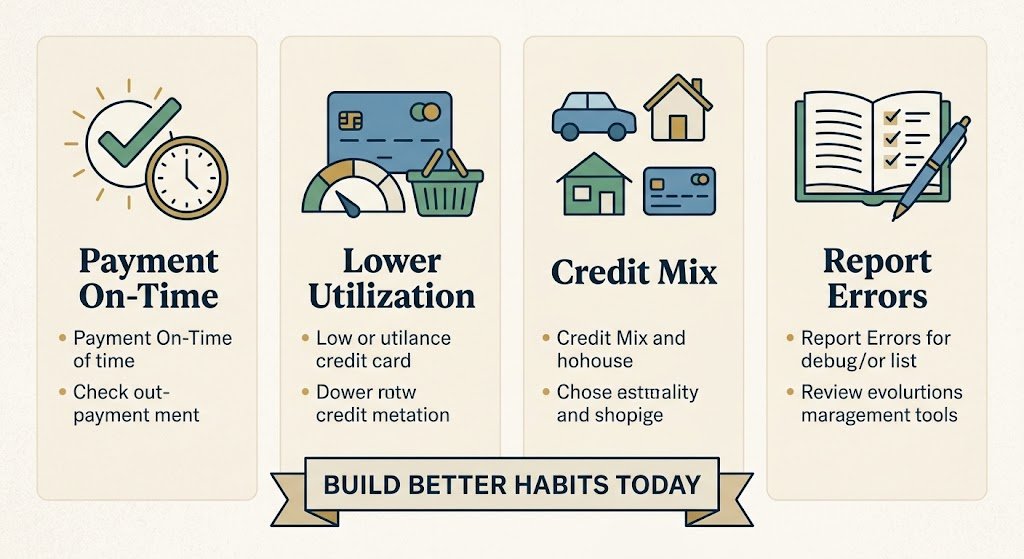
Learning how to improve credit score can feel confusing, since so much of the process happens behind the scenes at the credit bureau. Once you understand the credit score factors that actually matter, though, the path forward becomes much clearer. This guide covers exactly how to improve credit score, from understanding your credit report to building the habits that keep your score climbing over time.
Quick answer: How to improve credit score comes down to a few core habits: make on-time payments consistently, keep your credit utilization low, avoid opening too many new accounts at once, and give your credit history time to grow.
Why Does Learning How to Improve Credit Score Matter?
Your credit score affects far more than whether you get approved for a credit card. Lenders use it to help set interest rates on mortgages, auto loans, and personal loans, and some landlords and even employers check credit history as part of their screening process. A higher score can translate directly into lower borrowing costs over your lifetime, sometimes saving thousands of dollars on a single mortgage.
Understanding how to improve credit score also gives you more financial flexibility. A strong score opens up better card rewards, higher credit limits, and more favorable loan terms, all of which compound over time in your favor.
Beyond individual purchases, a strong score can also shape bigger life decisions, such as qualifying for a preferred apartment, negotiating a better rate on a car lease, or securing a more favorable mortgage when the time comes. Because these factors get evaluated repeatedly throughout life, the habits behind how to improve credit score tend to pay off well beyond any single application.
What Are the Main Credit Score Factors?
Credit scoring models, including the widely used FICO score, weigh several factors differently. Understanding this breakdown helps you know where to focus your effort first.
- Payment history (about 35%): Whether you’ve paid your bills on time is typically the single largest factor in most scoring models.
- Credit utilization (about 30%): How much of your available credit you’re currently using, both per card and across all your accounts combined.
- Credit history length (about 15%): How long your accounts have been open, including the age of your oldest and newest accounts.
- Credit mix (about 10%): The variety of account types you manage, such as credit cards, an auto loan, or a mortgage.
- New credit and inquiries (about 10%): How many new accounts you’ve opened recently and how many hard inquiries appear on your credit report, since each credit inquiry can carry slightly different weight depending on the type.
Because payment history and credit utilization together make up roughly two-thirds of most scoring models, these two areas typically offer the fastest, most reliable path to improvement.
Does How to Improve Your Credit Score Differ by Starting Point?
The core factors stay the same for everyone, but the priority shifts depending on where you’re starting from.
- No credit history yet: The first goal is simply establishing a credit history, often through a secured credit card or a credit builder loan, since scoring models need at least a few months of activity to generate a score at all.
- Thin credit file: With one or two accounts and limited history, keeping utilization low and every payment on time matters more than anything else, since there isn’t much other data yet to balance out a misstep.
- Rebuilding credit after a setback: Past late payments or a collections account will fade in impact over time, but the fastest progress usually comes from consistent on-time payments going forward combined with correcting any credit report errors that may be inflating the damage.
- Already-strong credit: At this stage, gains tend to come from fine-tuning credit card utilization and being selective about new applications, since the biggest factors are already well established.
Wherever you’re starting from, the same credit score factors apply; only the emphasis changes.
How Do You Improve Credit Score, Step by Step?
Here is a practical sequence to follow once you understand the factors above.
Step 1: Pull Your Credit Report and Check for Errors
Start by requesting your credit report from each major credit bureau. Review it carefully for mistakes, such as accounts that aren’t yours, incorrect balances, or payments marked late that were actually on time. Errors on a credit report are more common than most people expect, and correcting them can produce a quick, meaningful improvement.
Step 2: Set Up Automatic Payments
Since payment history carries the most weight, automating at least the minimum payment on every account removes the risk of an accidental late payment. On-time payments build positive history month after month, which is the foundation everything else builds on.
Step 3: Lower Your Credit Utilization
Pay down balances where you can, and consider requesting a credit limit increase on cards you already manage responsibly, since this lowers your credit card utilization even if your spending stays the same. Many experts suggest keeping utilization under 30%, with even lower levels producing stronger results.
Step 4: Avoid Opening Too Many New Accounts at Once
Each new application typically triggers a hard inquiry, which can cause a small, temporary dip in your score. Spacing out new applications gives your credit history time to mature between each one.
Step 5: Let Time Work in Your Favor
Credit history length matters, so keeping older accounts open and in good standing, even ones you don’t use often, generally helps more than closing them. Rebuilding credit or growing a thin credit file both benefit from patience as much as from any single action.
How Long Does It Take to See Results?
Results vary depending on your starting point and which factors you’re addressing. Correcting an error on your credit report can sometimes produce a change within a billing cycle or two, since the credit bureau simply updates an inaccurate entry. Building payment history or lowering credit card utilization tends to show measurable improvement within a few months of consistent habits, while credit history length naturally takes longer, since it only grows with time.
For a more focused breakdown of quicker wins, see our guide on how to improve credit score fast, which covers the specific actions that tend to move the needle soonest.
What Role Does Credit Utilization Play?
Credit utilization, the percentage of your available credit you’re currently using, is one of the more flexible factors to influence quickly. Unlike credit history length, which only grows with time, utilization can change from one billing cycle to the next based on your balances and credit limits.
A useful target is our detailed guide on what is a good credit utilization ratio, which explains both the overall and per-card thresholds worth aiming for and why keeping several cards under a low utilization often outperforms keeping just one very low.
How Do You Choose the Right Credit Card While Building Your Score?
The right credit card depends heavily on your current credit history. Someone with little to no credit history often benefits most from a secured credit card or a credit builder loan, both of which are designed specifically to help establish or rebuild credit with lower approval barriers. Someone with an established, healthy credit history has more options, including cards with stronger rewards.
Our comparison of best credit cards for beginners walks through several starter options, including secured cards and cards designed for a limited credit history, so you can choose one that fits your current situation rather than one built for an already-strong profile.
How Does a Secured Credit Card Help Build Credit?
A secured credit card requires a cash deposit that typically becomes your credit limit, which lowers the risk for the card issuer and makes approval easier for people with limited or damaged credit history. Using it responsibly, meaning small charges paid off in full and on time each month, reports positive payment history to the credit bureau just like a traditional card. Our full explanation of how a secured credit card works covers how to choose one and eventually graduate to an unsecured card.
What Should You Do If You Find an Error on Your Credit Report?
Errors on a credit report can drag down a score for reasons that have nothing to do with your actual financial behavior. If you spot an error, whether it’s an incorrect balance, an account that isn’t yours, or a payment mistakenly marked late, you have the right to file a credit dispute directly with the credit bureau reporting the mistake.
The dispute process typically involves submitting supporting documentation and waiting for the bureau to investigate, usually within 30 days. Our step-by-step guide on how to dispute credit report errors walks through exactly how to file a dispute and what to do if the first attempt doesn’t resolve the issue.
What Tools Help You Track Progress?
Free credit monitoring, offered by many banks, card issuers, and dedicated apps, makes it easier to watch your score and credit report change over time without triggering a hard inquiry. Most tools update your score monthly and flag new accounts, hard inquiries, or sudden balance changes, which helps you catch potential fraud early alongside tracking your own improvement.
Pairing regular credit monitoring with the habits above turns how to improve credit score from a one-time project into an ongoing routine. Seeing the number move, even gradually, tends to reinforce the behaviors that got it moving in the first place.
What Habits Help You Keep Improving Your Credit Score Over Time?
A handful of ongoing habits help maintain and continue building on progress once your credit score starts moving in the right direction:
- Check your credit report regularly. Free credit monitoring, offered by many banks and card issuers, helps you catch errors or signs of fraud early.
- Keep old accounts open. Closing your oldest card can shorten your average credit history length, even if you rarely use that account.
- Be selective about becoming an authorized user. Being added as an authorized user on someone else’s well-managed account can help build credit history, but the reverse is also true if that account is mismanaged.
- Understand soft inquiry vs hard inquiry. Checking your own score through most monitoring tools counts as a soft inquiry and doesn’t affect your score, while formal loan or credit card applications trigger a hard inquiry that can cause a small dip.
- Diversify your credit mix over time, naturally. You don’t need to open new account types purely to improve your credit mix; this factor carries less weight than payment history and utilization, and it tends to improve naturally as your financial life grows.
- Avoid credit repair services promising instant results. Legitimate credit repair mainly involves disputing genuine errors and building healthy habits; services that guarantee a specific score increase quickly are worth researching carefully before paying any fee.
- Keep your credit card utilization steady across the month. Some card issuers report your balance on a specific statement date rather than at the time you pay, so paying down a large purchase before that date can lower the utilization figure that actually gets reported.
Frequently Asked Questions About How to Improve Credit Score
Most common scoring models place scores from roughly 670 to 739 in the “good” range, 740 to 799 as “very good,” and 800 and above as “exceptional.” Ranges can vary slightly between scoring models, so it’s worth checking which one a specific lender uses.
No. Checking your own score or report is generally a soft inquiry, which has no impact on your credit score. Only hard inquiries, typically triggered by new applications, can cause a small temporary dip.
A single late payment can lower a score noticeably, especially if it’s the first one on an otherwise clean payment history, and it can stay on a credit report for up to seven years. The impact generally fades over time as more positive payment history accumulates.
Yes. A credit builder loan, becoming an authorized user on a well-managed account, or having certain rent and utility payments reported can all contribute to building credit history without a traditional card.
Paying in full each month is generally the better strategy. Carrying a balance doesn’t help your score and only adds interest charges; utilization is based on your statement balance, not on whether you carry debt month to month.
Most scores update whenever a credit bureau receives new information from a lender, which for most accounts happens monthly. This means consistent on-time payments and lower balances typically show up in your score within one to two billing cycles.
It can, mainly because closing an account can shorten your average credit history length and reduce your total available credit, which raises your overall credit utilization even if your spending stays the same. Keeping older cards open and using them occasionally is often the better approach.
A credit report is the detailed record of your accounts, balances, and payment history maintained by each credit bureau. A credit score is a single number calculated from that report using a scoring model like FICO, meant to summarize your creditworthiness at a glance.
Key Takeaways for How to Improve Credit Score
Learning how to improve credit score comes down to a manageable set of habits: check your credit report for errors, prioritize on-time payments, keep credit utilization low, and avoid opening too many new accounts in a short period. Payment history and utilization carry the most weight, so focusing there first tends to produce the fastest visible progress, while credit history length simply needs time and continued good habits. Whether you’re rebuilding credit after a setback or building a credit history from scratch, the same core factors apply, and consistent, patient effort tends to outperform any shortcut.