50/30/20 Budget Rule: How It Works, Examples and a Free Calculator
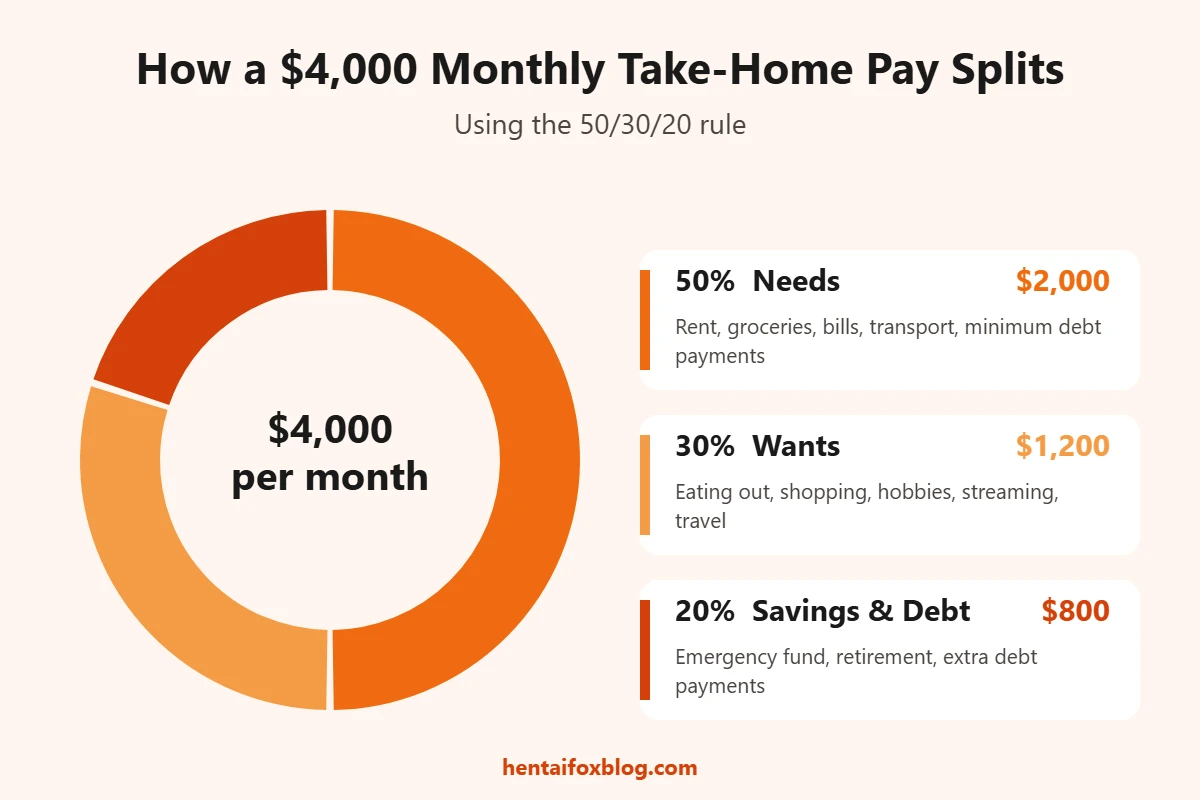
Quick answer: The 50/30/20 budget rule splits your after-tax income into three parts: 50% for needs, 30% for wants and 20% for savings and extra debt payments. On a $4,000 monthly take-home pay, that means $2,000 for needs, $1,200 for wants and $800 for savings or debt.
If budgeting has always felt like too much work, you are not alone. Most people quit because they try to track twenty different categories and burn out within a month. This method is popular for one simple reason. You only watch three numbers.
In this guide, you will learn how the 50/30/20 budget rule works, what counts as a need or a want, and how it looks at different income levels. You will also get a free calculator, a step by step setup plan and honest advice for when the numbers do not fit your life.
What Is the 50/30/20 Budget Rule?
The 50/30/20 budget rule is a simple way to divide your take-home pay. It was made popular by U.S. Senator Elizabeth Warren and her daughter Amelia Warren Tyagi in their 2005 book, All Your Worth: The Ultimate Lifetime Money Plan.
The idea is that you do not need to track every coffee you buy. Instead, you make sure your money lands in three healthy buckets. If each bucket stays close to its target, your budget is in good shape.
How the 50/30/20 Rule Works
Under the 50/30/20 budget rule, every dollar you take home goes into one of three groups. Here is what belongs in each one.
50% for Needs
Needs are the bills you must pay to live and work. If you lost your job tomorrow, you would still have to cover them. Common needs include:
- Rent or mortgage payments
- Utilities like electricity, water and gas
- Basic groceries
- Transport to work, such as fuel or a bus pass
- Health insurance and medicine
- Minimum payments on loans and credit cards
- Childcare that allows you to work
30% for Wants
Wants, on the other hand, make life enjoyable, but you could live without them for a while. This is the first bucket to cut when money is tight.
- Eating out and food delivery
- Streaming services and other subscriptions
- New clothes beyond the basics
- Hobbies, gym memberships and travel
- Upgrades, like a newer phone or a nicer car than you really need
20% for Savings and Debt Payoff
Finally, this bucket builds your future. It covers anything that grows your net worth or shrinks what you owe.
- Building an emergency fund
- Retirement contributions
- Extra payments on debt, above the minimum
- Saving for big goals like a home deposit or education
In other words, only the minimum debt payment counts as a need. Anything extra goes in the 20% bucket because it speeds up your progress. If you carry high interest debt, our guide on how to get out of debt will help you choose a payoff plan.
Needs vs Wants: Where Common Expenses Fit
Some expenses are easy to sort. However, others sit in a gray area. Use this table as a starting point, then decide based on your own situation.
| Expense | Usually a Need | Usually a Want |
|---|---|---|
| Groceries | Basic food and household items | Snacks, premium brands, takeaway |
| Phone | A basic plan you need for work | The newest model or a top tier plan |
| Car | Reliable transport to work | A luxury model or a second car |
| Internet | A standard connection for work or school | Speed tiers you never use |
| Clothing | Work clothes and seasonal basics | Fashion and designer items |
| Fitness | Physical therapy your doctor recommends | A premium gym membership |
For this reason, a quick test helps. Ask yourself: if I skipped this for three months, would my health, job or home be at risk? If the answer is yes, it is a need. If not, it is a want.
50/30/20 Budget Rule Examples at Different Incomes
Here is how the 50/30/20 budget rule looks at a few common monthly take-home pay levels.
| Monthly Take-Home Pay | Needs (50%) | Wants (30%) | Savings and Debt (20%) |
|---|---|---|---|
| $2,500 | $1,250 | $750 | $500 |
| $4,000 | $2,000 | $1,200 | $800 |
| $6,000 | $3,000 | $1,800 | $1,200 |
| $8,000 | $4,000 | $2,400 | $1,600 |
A Simple Real Life Example
Imagine Sara, a teacher who takes home $3,200 a month. Her targets are $1,600 for needs, $960 for wants and $640 for savings and debt.
When she tracked her spending, her needs came to $1,750 because of rent. Her wants were $1,100, and she was saving only $350. So she cancelled two streaming services, cooked at home four nights a week and set up an automatic transfer of $290 a month. Her needs are still a little high, but her savings almost doubled to $640, right on target.
Free 50/30/20 Budget Calculator
Type your monthly after-tax income below to see your 50/30/20 budget rule targets instantly.
Works with any currency. Amounts are rounded to the nearest whole number.
How to Use the 50/30/20 Budget Rule in 5 Steps
Setting up the 50/30/20 budget rule takes about an hour. Follow these five steps.
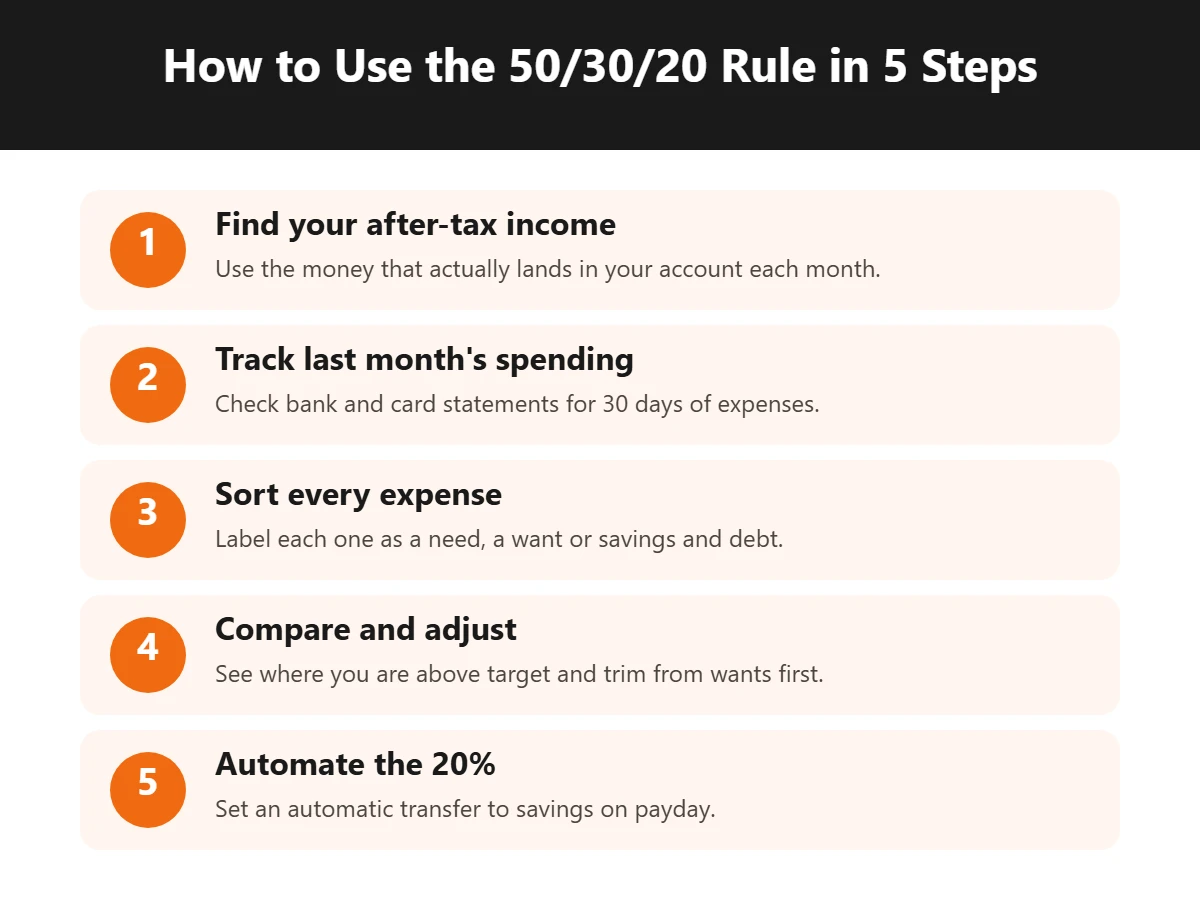
Step 1: Find Your After-Tax Income
Start with the money that actually reaches your bank account each month. If your employer already takes out retirement savings or health insurance, add those back and count them in the right bucket. Retirement goes in savings and health insurance goes in needs. If you are self employed, subtract the money you set aside for taxes first.
Step 2: Track Last Month’s Spending
Download your bank and card statements for the last 30 days. You can use a spreadsheet, a notebook or an app. Our review of the best personal finance apps can help you choose one.
Step 3: Sort Every Expense Into a Bucket
Then mark each expense as a need, a want or savings and debt. Next, add up each group, then divide by your income to get a percentage.
Step 4: Compare and Adjust
Compare your real numbers with the 50, 30 and 20 targets. If wants are too high, trim them first because they are the easiest to change. If needs are too high, read the next section.
Step 5: Automate Your Savings
Set up an automatic transfer to a separate savings account on payday. As a result, when money leaves before you can spend it, saving becomes a habit instead of a daily decision. You will find more easy habits in our guide on how to save money.
What If Your Needs Are More Than 50%?
First of all, this is very common, especially in cities with high rent or for families paying for childcare. It does not mean the 50/30/20 budget rule has failed. It simply means you need to adjust.
- Use a temporary 60/20/20 split. Take the extra 10% from wants, not from savings.
- Go after big costs first. Housing and transport usually offer bigger wins than small daily cuts.
- Shop around once a year for insurance, phone and internet plans.
- Look at consolidating high interest debt if it lowers your monthly payments.
- Grow your income with a side hustle so the same bills take up a smaller share.
Treat 50% as a goal to work toward, not a test you must pass on day one.
How to Budget With an Irregular Income
Freelancers, gig workers and people paid on commission often find budgeting harder because their income changes every month. Here is a simple fix.
- Look at the last six to twelve months and find your lowest earning month.
- Build your 50/30/20 plan around that lower number.
- In good months, send everything above that baseline to savings and debt first.
- Keep a buffer of at least one month of expenses so a slow month does not throw you off track.
Who Should Use the 50/30/20 Budget Rule?
This budget is a great fit if you are new to budgeting, earn a steady salary and want a plan that does not take hours every week. It also works well for couples who want a simple shared system, because three buckets are easy to agree on.
It may not be the best choice if you are trying to pay off a large amount of high interest debt quickly, live in a very expensive city or have a big savings goal on a short timeline. In those cases, a stricter plan or a custom split like 60/10/30 can help you move faster.
Pros and Cons of the 50/30/20 Budget Rule
Pros
- Easy to set up in under an hour
- No need to track dozens of categories
- Includes money for fun, so it is easier to stick with
- Makes saving regular and automatic
- Works well for beginners with a steady income
Cons
- Hard to follow with high rent or a low income
- Broad buckets can hide overspending in one area
- 20% may be too little for big goals like early retirement
- Gray area expenses can be sorted to suit you
- Slower for paying off large debts quickly
50/30/20 vs Other Budgeting Methods
| Method | How It Works | Best For |
|---|---|---|
| 50/30/20 | Splits income into needs, wants and savings | Beginners who want a simple plan |
| 70/20/10 | 70% spending, 20% savings, 10% debt or giving | People with high living costs |
| 80/20 | Save 20% first, then spend the rest freely | People who dislike tracking |
| Zero based budget | Every dollar gets a job until income minus spending equals zero | Detail lovers and tight budgets |
| Envelope method | Cash or digital envelopes for each category | People who overspend on cards |
In the end, there is no single best method. The best budget is the one you will actually follow. Many people start with the 50/30/20 budget rule and move to a more detailed system later.
Common Mistakes to Avoid
- Using gross income. Your targets will be too high. Always use take-home pay.
- Counting extra debt payments as needs. Only the minimum belongs there.
- Putting every gray area expense in needs. Be honest with yourself.
- Forgetting yearly costs like insurance or car repairs. Divide them by 12 and plan for them monthly.
- Giving up after one bad month. Adjust the numbers and keep going.
Frequently Asked Questions
Is the 50/30/20 rule based on gross or net income?
It uses net income, which is your pay after taxes. If retirement savings or health insurance come out of your paycheck, you can add them back and count them in the right bucket.
Does rent count as a need?
Yes. Rent or a mortgage payment is a need. If housing alone takes up most of your 50%, follow the tips in the section on what to do when needs go over 50%.
Is the 50/30/20 rule good for beginners?
Yes. It is one of the easiest budgets to start because you only manage three categories instead of dozens.
Should I follow the 50/30/20 split monthly or weekly?
Most people use it monthly because bills are usually paid that way. If you are paid weekly, apply the same percentages to each paycheck.
Where does debt go in a 50/30/20 budget?
Minimum payments go in needs. Any extra payment above the minimum goes in the 20% savings and debt bucket.
What is the difference between the 50/30/20 and 70/20/10 rules?
The 70/20/10 rule puts 70% toward all spending, 20% toward savings and 10% toward debt or giving. It can suit people whose essential costs are already high.
Final Thoughts
The 50/30/20 budget rule works because it is simple. You do not need to be good at math or love spreadsheets. You only need to know three numbers and check them once a month.
So start today. Use the calculator above, track one month of spending and set up a small automatic transfer. Small steps add up faster than you think.
Sources: Elizabeth Warren and Amelia Warren Tyagi, All Your Worth: The Ultimate Lifetime Money Plan (2005). Budgeting tools from the Consumer Financial Protection Bureau.
Disclaimer: This article is for educational purposes only and is not financial advice. Please read our full disclaimer.