How to Build an Emergency Fund: 7 Simple Steps (Even on a Low Income)
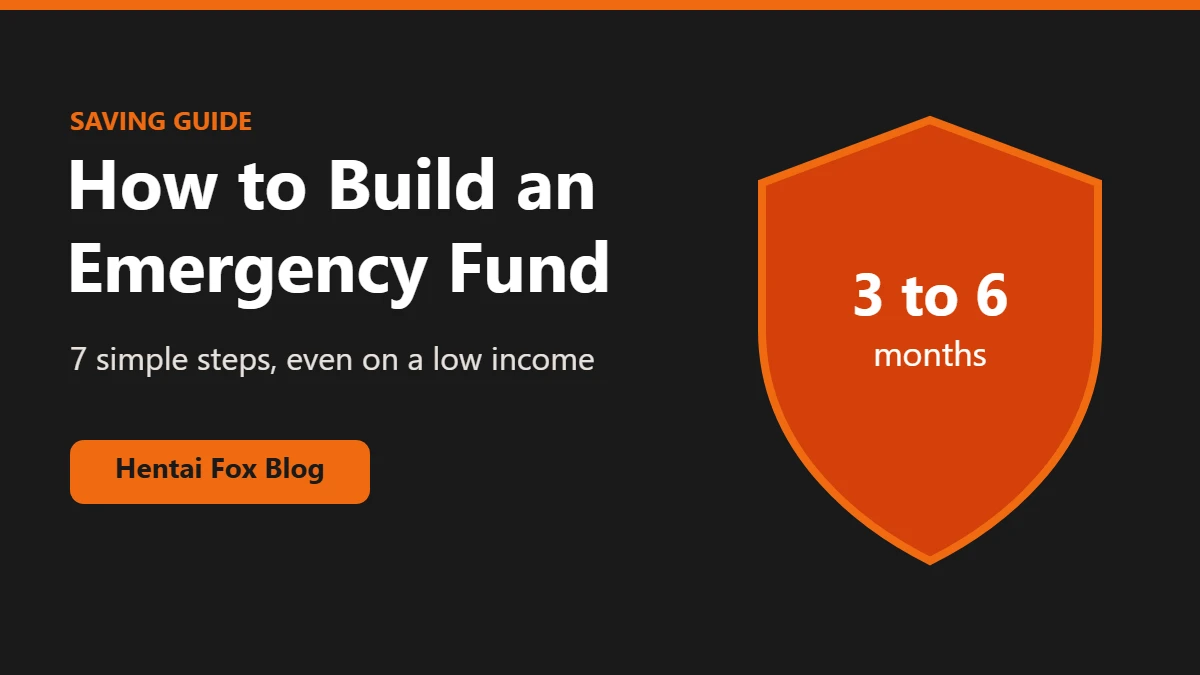
Quick answer: To build an emergency fund, start with a small goal of $500 to $1,000, open a separate savings account and set up an automatic transfer every payday. Then grow it step by step until it covers three to six months of essential expenses.
A surprise bill can turn a normal month into a stressful one. For example, your car breaks down, a family member gets sick or work suddenly slows down. Without savings, however, many people have no choice but to use a credit card or borrow money.
That is exactly why you should build an emergency fund before almost any other money goal. In this guide, you will learn how much you need, where to keep it and seven simple steps to get there, even if your income is small. You will also get a free calculator to plan your own timeline.
What Is an Emergency Fund?
An emergency fund is money you set aside only for real emergencies. Think of a job loss, a medical bill or an urgent home repair. In contrast, it is not for holidays, shopping or planned expenses.
The main goal is peace of mind. When you have cash ready, a surprise cost becomes an inconvenience instead of a crisis. As a result, you avoid high interest debt and protect the rest of your budget.
How Much Emergency Fund Do I Need?
Most experts recommend saving three to six months of essential expenses. In other words, count only the costs you must pay to live, not your full spending. However, the right number depends on your situation.
| Your Situation | Suggested Target |
|---|---|
| Stable salary, single, no dependents | 3 months |
| Two incomes in the household | 3 to 4 months |
| One income supporting a family | 6 months |
| Self employed, freelance or commission pay | 6 to 12 months |
| Health issues, an older car or an older home | Aim for the higher end of your range |
How to Work Out Your Number
- List your essential monthly costs: rent, utilities, groceries, transport, insurance, medicine and minimum debt payments.
- Add them up.
- Multiply the total by the number of months you want to cover.
For example, if your essentials add up to $2,200 a month, a three month fund is $6,600 and a six month fund is $13,200. That may sound like a lot. Fortunately, you do not need it all at once.
Free Emergency Fund Calculator
Enter your numbers below to see your target and how long it will take to build your emergency fund at your current pace.
Works with any currency. Results are estimates and do not include interest.
How to Build an Emergency Fund in 7 Steps
These seven steps work for almost any income. Take them one at a time and keep moving forward.
Step 1: Set a Starter Goal
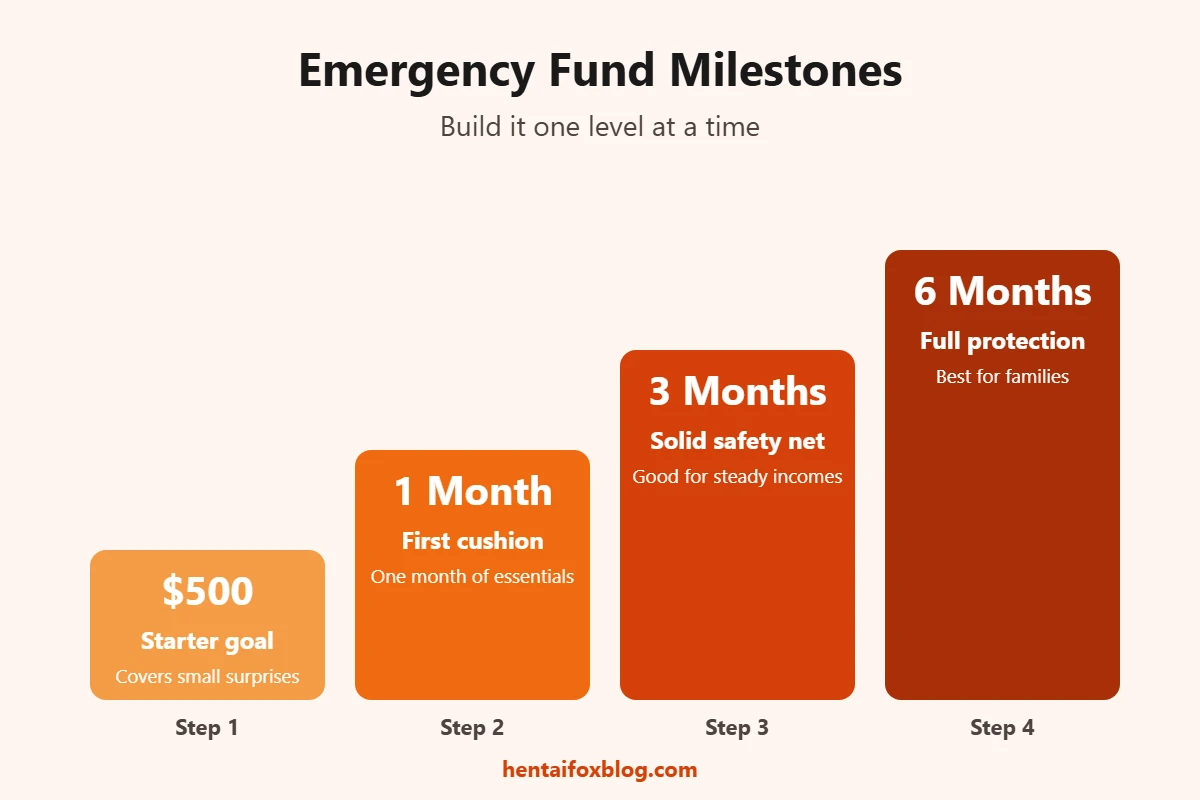
When you first build an emergency fund, a full six month target can feel impossible. So start smaller. Aim for $500 or $1,000 first. This starter cushion covers many common surprises, like a car repair or a vet visit, and it gives you a quick win that builds motivation.
Step 2: Work Out Your Full Target
Next, use the steps above or the calculator to find your full three to six month number. Write it down. After that, break it into milestones: starter goal, one month, three months and finally six months.
Step 3: Open a Separate Account
To build an emergency fund that lasts, keep your savings away from your everyday spending account. Otherwise, when the money sits in the same place, it is far too easy to spend it by accident. Ideally, choose a savings account at a different bank so it takes a little effort to move the money.
Step 4: Automate Your Savings
Set up an automatic transfer to your emergency account on payday. In simple terms, this is called paying yourself first. In fact, even $25 a week adds up to $1,300 in a year. If you follow the 50/30/20 budget rule, this money comes from your 20% savings bucket.
Step 5: Find Extra Money in Your Budget
Look through last month’s spending for easy wins. For instance, cancel subscriptions you rarely use, cook at home a few more nights or switch to a cheaper phone plan. Then send the money you save straight to your fund. Our guide on how to save money has more simple ideas.
Step 6: Save Your Windfalls
Tax refunds, bonuses, cash gifts and money from selling things you no longer use can speed up your progress. As a rule, try to put at least half of every windfall into your fund until you reach your goal.
Step 7: Protect It and Refill It
Above all, only touch this money for real emergencies. If you do use it, pause other savings goals and refill it first. Also, review your target once a year, because rent, family size and income change over time.
How Long Will It Take to Build Your Emergency Fund?
Here is how long it takes to reach common goals at different weekly savings amounts. As you can see, even small amounts make a real difference over time.
| Weekly Savings | Reach $500 | Reach $1,000 | Reach $5,000 |
|---|---|---|---|
| $10 | 50 weeks | 100 weeks | 500 weeks |
| $25 | 20 weeks | 40 weeks | 200 weeks |
| $50 | 10 weeks | 20 weeks | 100 weeks |
| $100 | 5 weeks | 10 weeks | 50 weeks |
In addition, adding windfalls or a side income can cut these times a lot. For instance, a single $600 tax refund puts a $25 a week saver more than halfway to $1,000 on day one.
How to Build an Emergency Fund on a Low Income
When money is tight, saving can feel impossible. Still, you can build an emergency fund on a small income with the right approach. Most importantly, focus on progress, not perfection.
- Start tiny. Even $5 or $10 a week builds the habit. You can raise it later.
- Split your paycheck. Ask your employer to send a small, fixed amount straight to your savings account.
- Use round up tools. Some banks and apps round each purchase up and save the change. Our finance apps review covers a few options.
- Cut one bill. Lowering just one regular cost, such as a phone or internet plan, can free up money every month.
- Earn a little extra. A small side hustle for a few hours a week can fund your savings faster.
- Celebrate milestones. Every $100 saved is a win. Notice it and keep going.
Emergency Fund Tips for Freelancers and Gig Workers
If your income changes from month to month, your savings plan needs a little more structure. A slow month is not a surprise for a freelancer. Instead, it is part of the job, so your safety net should be bigger.
- Aim for six to twelve months of essential costs instead of three.
- Save a fixed percentage of every payment you receive, such as 10%, rather than a fixed amount.
- Keep taxes separate. Money you owe in taxes is not part of your emergency savings.
- Use your best months wisely. When a big client pays, top up your fund before you spend anything extra.
This approach lets you build your emergency fund faster in good months, so the quiet months feel far less stressful.
Where to Keep Your Emergency Fund
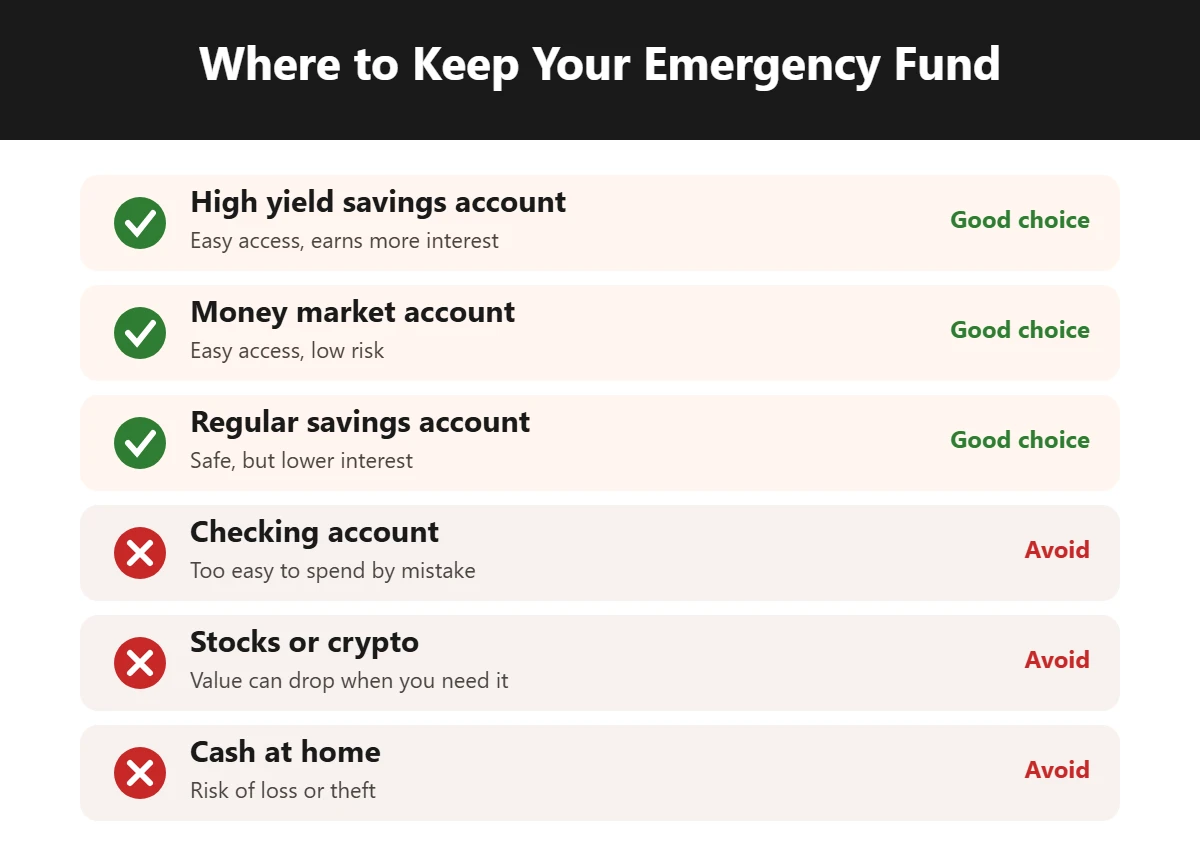
As you build your emergency fund, the money needs to be safe and easy to reach, but not so easy that you spend it. Here is how the main options compare.
| Account Type | Access | Risk | Good for an Emergency Fund? |
|---|---|---|---|
| High yield savings account | 1 to 2 days | Very low | Yes, best for most people |
| Money market account | 1 to 2 days | Very low | Yes |
| Regular savings account | Same day or next day | Very low | Yes, but earns less |
| Checking account | Instant | Very low, but easy to spend | Only for a small buffer |
| Certificate of deposit (CD) | Penalty for early withdrawal | Low | Only for part of a large fund |
| Stocks or crypto | Must sell first | High | No |
In the United States, check that your bank is insured by the FDIC, or that your credit union is insured by the NCUA. These protect deposits up to $250,000 per depositor, per insured bank, for each account ownership category. If you live elsewhere, look up your local deposit protection scheme.
What Counts as an Emergency?
Before you dip into your fund, ask three questions. Was it unexpected? Do you truly need it? And does it have to be paid right now? If the answer to all three is yes, it is probably a real emergency.
Real emergencies
- Losing your job or a big drop in income
- Medical or dental bills you cannot delay
- Car repairs you need to get to work
- Urgent home repairs, like a broken boiler
- Emergency travel for a family crisis
Not emergencies
- Holidays and weekend trips
- Sales and shopping deals
- A new phone when the old one still works
- Planned costs like yearly insurance
- Gifts and celebrations
Emergency Fund or Paying Off Debt First?
This is, without doubt, one of the most common questions. A balanced approach works well for most people:
- Save a starter fund of $500 to $1,000.
- Put extra money toward high interest debt, like credit cards.
- Once that debt is gone, grow your fund to three to six months.
This way a surprise bill does not push you deeper into debt while you pay it off. For a full plan, read our guide on how to get out of debt.
Common Mistakes to Avoid
- Waiting until you can save a lot. Small amounts started today beat large amounts that never start.
- Keeping it in your checking account. It will slowly disappear into everyday spending.
- Investing it. A market drop could shrink your safety net right when you need it.
- Using it for wants. Sales and holidays are not emergencies.
- Forgetting to refill it. After you use it, make rebuilding your first priority.
Frequently Asked Questions
How much should I have in my emergency fund?
Most experts suggest three to six months of essential expenses. Choose the lower end if you have a stable job and no dependents, and the higher end if you support a family or have an irregular income.
Is $1,000 enough for an emergency fund?
It is a great starter goal and covers many small emergencies, like a car repair or a vet bill. However, it is usually not enough to cover a job loss, so keep building after you reach it.
Should I invest my emergency fund?
No. Stocks and crypto can fall in value right when you need the money. Keep your emergency fund in a safe, easy to reach account and invest money you will not need for several years.
Should I save an emergency fund or pay off debt first?
Many people build a small starter fund of $500 to $1,000 first, then focus on high interest debt, then grow the fund to three to six months. This way a surprise bill does not push you deeper into debt.
What is the difference between an emergency fund and a sinking fund?
An emergency fund is for surprises you cannot plan for, like a job loss. A sinking fund is money you set aside for expected costs, like a holiday or a yearly insurance bill.
What should I do after I use my emergency fund?
Refill it as soon as you can. Go back to your starter goal first, then rebuild to your full target by restarting your automatic transfers.
Final Thoughts
You do not need a big salary to build an emergency fund. Instead, you need a clear goal, a separate account and a small automatic transfer that you never skip.
So start today. Set your starter goal, use the calculator above and schedule your first transfer for your next payday. Future you will be very glad you did.
Sources: Consumer Financial Protection Bureau and FDIC deposit insurance.
Disclaimer: This article is for educational purposes only and is not financial advice. Please read our full disclaimer.